Monday, August 22, 2011

Pro Comps. Too much Drama? What's Going On? (part 4 of 4)


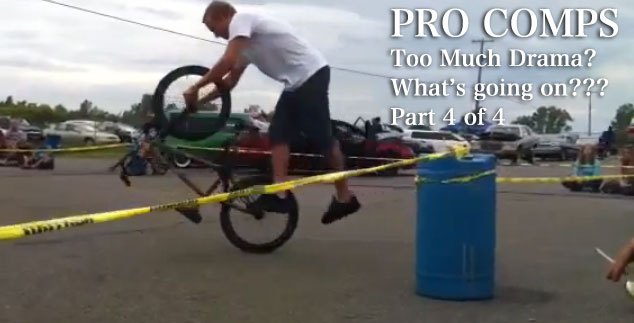
Dane Beardsley takes first at the final stop of the AM flat circuit, 2011. The largest flatland circuit in the USA!

Part 4!

Yesterday we left off talking about moving from a "comps + sponsors" way of thinking to a "shows + sponsors" for making it as a pro rider and how to organize ourselves to be able to handle TV appearances and commercials.

Bobby: All that needs to be discussed with the riders and input given from different people's experience.

Effraim: Seems like you agree bobby we are at an all time low

Bobby: hmmmm....depends on what aspect you are talking about...

Effraim: Contests, lack of structure.

Bobby: I think we were at an all time low right after x-games dropped us and before the first Voodoo jam. At least now flatlanders are still trying to do something for flatland, organizing flatland jams and events. That stuff wasn't going on as much as during x-games era.

Effraim: The positives are the amount of blogs, websites popping up, motvating riders daily. The x games was just a paycheck.
There was no judging system that i knew of in place. "Why did i get that score?" You know what i mean? People need to get a reality check and work for the long term. Not the short term pay check.

Bobby: Yes. I think there are a lot of possibilities, but we will have to think differently and experiment with new things, not just go through the same motions over and over again, expecting a different result. I don't think judging is appropriate for pro riders. They need the freedom to create their own tricks and flow. They need to create and ride without worrying about doing things that the judges will like. Just like Martti does in his web edits.

Effraim: I always remember Steve Mulder...How on earth did i ever beat that guy? The guy was a machine, one of the best riders, but because he had one hit tricks and i had combos, I'd place higher What was harder? His tricks for me.
No system in place for judges to go "wait a minute?"

Bobby: See what I mean... let Mulder do what he does and let Big E do what Big E does. No need for judging. You guys have created different albums. You guys can do more good working together than battling against each other these days.

Effraim: I see what your saying..hahaha! i like that. Well right now my album would be called "Less is More."

Bobby Carter: Nice!

Effraim: Hence the clips not edits.. Its to the point.

Bobby: Right. Understood.

Effraim: What were you saying about martti? We got side tracked there?

Bobby: He's achieving what I call "pure flatland." He's doing what he wants to do on his bike free of judgement.

Effraim: Yes, hes a purist, he's one of a dying breed you might say. He hasn't given up the fight.

Bobby: Or maybe the first of new breed that has yet to be born?

Effraim: We'll he's one of a kind, that's for sure. He's a role model in so many ways. Look how he broke up that fight at fise. He could have walked away. I know he wanted to. I wanted to also.

Bobby: I wasn't there, so I didn't see the altercation...

Effraim: I'm just saying hes a role model.

Bobby: Word.

Effraim: He didn't have to do that. He inspires....Intrikat video parts, his contest training methods inspired a new generation (terry, justin for example)...junglerider...groundtactics....He's active.

Bobby: The Intrikat years...That was a sweet era. Now let's see what's in store for the next era.

Effraim: He brought video tricks to the contests. So it can be done. If you want it?
Do you want it? How much do you want it?

Bobby: Do I want what?

Effraim: I'm just saying in general..if you want something, make it happen, nothings impossible.

Bobby: Yes, somethings happen, maybe not in the way you first envisioned them, but they happen.

Effraim: Exactly, someone's interpretation..there's room for so much in flatland.

Bobby: I think that people want flatland to grow, but I don't think that's going to happen through pro comps...probably more likely through shows, demos, jams, commercials, TV appearances etc., web blogs, etc.

Effraim: Sure everyone does. Just needs a central point to flow out of.


Terry Adams handling business on MTV Singapore.

Bobby: And on the underground, the tricks are just going to keep getting harder. People are going to keep riding, that's not going to stop. Money or no money riders will find a way to ride...

Effraim: Of course they always have. No different than when i started.

Bobby: But for those who are inclined to putting in the effort to develop flatland, I think we have to experiment and think outside the "box" of pro-comps. I think there is a great opportunity for creativity at the moment for flatland companies. The web edits are a very efficient way for companies to let the world know what their company stands for and what they are about. A 4 minute web edit allows the world to focus on your brand and riders. Since comps are not covered very much in the magazines, there is the opportunity for flatlanders to come up with stories, link lifestyle with sport, and create interesting articles that magazines can print. This type of article can engage people much better than a contest report.

Effraim: So what are the solutions Bobby? Perhaps a independent panel to look at contest formats and see which format riders would like the best, I mean who decided almost every contest would be a battle? Who decides where each event will be in the World Circuit? Who decides there will be 4 rounds?
There's room for so much more, 2 run formats, 3 min runs, (i.e, Masters), its a big deal if you win the Masters. that contest in the past would attract big crowds and a lot of riders, 59 one year for example. I remember that one year at the Worlds in Koln, Martti kicked all our asses hard, he brought the house down, that was one of the loudest crowds for flatland I've ever heard, without a drop of showmanship. There's other things like more recently Rad dad's Hitchhiker juggler contest, it kind of judges itself, its fun, it will no doubt bring people out of the woodwork to get involved and have a crack at that.

Bobby: Well, I don't have any solutions for the contests. That's the problem with contests...In my opinion they aren't the solution. Back in the day it was a different era. It was the main place in which we could exchange information with a bunch of other riders. It was a platform to show new tricks. Magazines covered these events extensively. Now we have the web edits to show new tricks and facebook to exchange information. Also, nobody will agree to one format. Deep crew will come up with their format for their comp, but then KOG will have a different set up, and yet Battle at the bricks another format, Jomo Pro will do their thing and so on.... Every time a formula is suggested, some organizer or some riders or both will throw a fit. If people want do comps, that's cool, they can do each pro comp as they see fit, but I don't see pro comps as the major component for the development of flatland anymore. That's just my opinion...

Bobby: Basically, pro flatland comps are like scrimmage games. It's for our own enjoyment within flatland, but it doesn't have the same impact as back in the day in terms of developing flatland. Except in specific situations like the Masters or Circle of Balance, they are not efficient at getting pro riders paid, nor are they efficient for brands to get their message across, and they are not efficient at engaging the pros with the rest of the riders. Jams are very efficient at letting AMs interact with Pros and see the products first hand. Web edits are very efficient at getting a brand's messaging across. They also allow riders to show their hardest tricks! Commercials, shows, corporate demos, flatland schools, and the sponsors one could get from these forms of exposure, could get pros paid while building the flatland community at the same time.


Well...that's the end of conversation Effraim and I had over a facebook chat. I hope you learned something. I hope you can share something with us. Thanks for reading. Keep riding! Keep experimenting! Keep enjoying flatland! Keep flatland FREEstyle!


Pro Comps. Too much Drama? What's Going On? (part 3 of 4)


Is this the magic formula for judging and making pro comps work?

Part 3 of 4

We left off yesterday talking about the two realms of flatland. The first pure riding for yourself. The second, "how do you make a living from flatland, if possible?"

Effraim: Riders are now openly bitching out the judges at every contest, its like the online forum went live to the contest. We need to get organized, have credibility, systems in place, if you are going to bitch, do it privately, not on a stage for all to see. Majority of times judges are there as volunteers. I mean you've been there Bobby, honestly, when was the last time you left a contest more stoked than when you arrived there?

Bobby: Seems to me that trying to judge flatland or apply some sort of standard formula doesn't work. Flatland is supposed to be free. I say let it be free and without judgement. Let the riders ride.

Effraim: So you can't have a contest? Equal prize money? Someone always wants a winner? You didn't answer bobby, when was the last time you left a contest more stoked than when you arrived there?

Bobby: It's been 8 years and only about 2 times, the first Voodoo Jam and World Classic...the other times I honestly was quite exhausted afterward and then bummed about the complaining. There is no formula that will work to judge flatland. No matter which way you approach it, there will be always be a huge flaw. I could go into it more, but look at it this way, the point of being a pro is to bring original and difficult tricks. In the theoretical situation where everyone pulled a flawless run of all original and difficult tricks, would everyone tie for first? At that point, you would have to choose a winner based off of what you "like", not on objective technical points. Although the chances of this happening is very small, we are still approaching that point. Especially as riders are getting more and more dialed in their routines. It's going to be negative drama every time....and you're volunteering to jump into it as a judge. Each year, negativity seems to get worse. There is no formula that will work without stifling the creativity of the riders. Look at the way they judge artistic cycling. The riders can only do certain tricks from their official trick book and each one has difficulty assigned and a proper way to execute it. You can't bust out some new trick and surprise everyone because they don't have an objective way to judge the new trick.

Effraim: Exactly and you're one of the positive dudes, I know. To me their needs to be a system in place where riders can voice their opinions, but do it in the right way this has been going on a while now.

Bobby: Well, most pros want to or are trying to somehow build a living out of flatland. The traditional way is comps + sponsors.

Effraim: Flatland is just static, the riding progresses at home but not at the contest.

Bobby: It usually works in other sports, but I think that flatland is a special situation...

Effraim: Look at Martti and what hes doing. Its beautiful! He's inspiring everyone in some way.

Bobby: Yes. We'll get to Martti in a second. heh heh!

Effraim: We need a governing body in place to deal with all these issues, share it between riders. At the moment, theres no money, so its a question of time.

Bobby: We don't sell tons of product...but I can name a handful of riders that make a living from doing shows, essentially selling flatland as entertainment. We got paid to do that Adidas commercial with Snoop. We didn't need to practice 5 in a row for that, we needed to know how to handle the situation with the production companies. But the industry doesn't focus on that. They focus on comps. Commercials and TV appearances have the potential to put BMX out there way more than a comp.

Kelloggs Frosted Flakes - BMX Freestyle from Sparks on Vimeo.


This frosted flakes commercial probably paid more to the riders than a pro comp and if it was broadcasted, has way more reach than comp coverage.


Effraim: Eddie Fiola came to Southsea on the GT World Tour back when i started. Curb dogs.

Bobby: I'm thinking the main strategy to help flatland grow and for pros to make a living is shows + sponsors. Look at Terry Adams...Sponsored athlete + demos all over the place. He's making a living from flatland...

Effraim: Its the riders holding onto the comps.

Bobby: The riders need to hold on to shows + sponsors. If it is even possible, the governing body should be helping to get shows that get riders paid. Seems as though the companies should be getting their riders out there doing demos, attending jams, and creating cool media that helps bring flatland to the riders and anyone else interested in viewing.

Effraim: If they want a living, yeah. Yes, that's good idea.

Bobby: The governing body, if one could even be assembled, should be going out and being a source of information for riders as well as sponsors.

Effraim: Exactly. Set up between a bunch of riders that love the sport for what it is, no vested interest.

Bobby: It should let riders know how to handle commercials, tv shows etc. That seems the best bet to me. Not comps.

Effraim: Make it happen, B!

Effraim: You have lot of good ideas, your ideally located.

Bobby: I'll try to do what I can, but it should be a global movement.

Effraim: As you say make your dreams a reality. Has to start somewhere. Basic structure. what are you trying to do? How do implement these ideas? How does it grow?
What is minimum fee for a show? All things that can be put in place...

Stay tuned for Part 4 tomorrow!

Pro Comps. Too much Drama? What's Going On? (part 2 of 4)


Yesterday, in part 1, we spoke about the business cycle of a pro comp and why some comps seemed to work in 2004. We left off thinking about what are the best aspects of a pro comp......

Part 2 of 4

Effraim: Good question. The best thing I can think of right now, is that everyone can see these events at least within 2-3 days after the contest worldwide. And on some occasions, live feed.

Bobby: Well aside from quick broadcasting, which is really just a function of the internet, what do you think is the best thing that pro comps have to offer flatland?

Effraim: To be honest I'm struggling.

Bobby: Haha!

Effraim: What do you think?

Bobby: I think it's a way to bring everyone together in person. At the Worlds or the Masters it's good to be represented with the rest of BMX.

Effraim: Right. But that's no different than a jam, or the x games 8 years ago...

Bobby: For someone on a team, I suppose they can tell a sponsor, their "ranking" on the circuit. To a lesser degree some people are actually competitive and like to "win" and this is a way to let that out. I think the jam is better suited for allowing people to mix it up. Ams can ride all day with Pros and riders have a lot of time exchange information.

Effraim: Yes, the ranking is good. In some ways, but as the sport has changed, majority of sponsors don't care what you placed at a contest. Look at the rest of BMX. Some of the biggest names, Chase Hawk, Aaron Ross, etc are not contest machines. And they are selling product.

Bobby: So it's an interesting predicament we are in...

Effraim: Yes it is...


Bobby: Flatland doesn't have enough riders to sell heaps of product. There's no surplus of money to really re-invest into the sport.

Effraim: Like LL Cool J said "at the crossroads, crossroads"
http://www.youtube.com/watch?v=HfKmKM-aM3A


Bobby: Flatland companies don't have the money to support their own pro events. We have to rely on outside money year after year....

Effraim: No we can't, and the contests are alienating more and more riders each time. People are staying home, enjoying their riding in the purest form which ultimately is what its all about anyway...

Bobby: Hmmmmm....It seems like the battle format and other features of the comps are set in place to get the crowd excited.

Effraim: Yes they were originally, but I don't see that it went down like that in the end.


Bobby: World Classic in Japan was really an experiment to prove the format of a big flatland TV show format.

Effraim: When I look back at some of the great runs of all time, the crowd was louder in a two run format 3 min run format. Way louder and now its a show. Certain riders do things to hype the crowd which you know. Its a become a show, and fake to some degree, i'm not into that, its far removed from everyday riding, majority of street riding friends think flat contests are gay...thats their perception.

Bobby: I'm thinking instead of concentrating on pro comps, in the professional realm, riders should be concentrating on selling flatland as entertainment. Comps are really just a rider on rider battle for honor as there is very little money to be won. However, if you had a Pro-level comp with no money, my guess, is that not many pros will show up. So that means the pro riders are chasing money to a certain extent.


Flatring 2006, "competition as a performance" ...

Bobby: Instead of trying to make a comp into a show, just straight up make flatland entertainment. Demos, school shows, commercials, tv shows, events, etc. Don't even worry about trying to beat the next pro in a battle, worry about how to get the next show contract or tv placement, that's the real battle. Get paid through that avenue instead of training for a comp where there is little exposure and little money. As a pro, you could go out and make a thousand dollars doing a set of shows, as opposed to $150 at a comp where you got 6th place and spent months training for it. Drop your hardest tricks in the videos to hype up what few riders are out there to buy your sponsor's product and go meet the riders at the jams.

Effraim: Flatland is about the individual, pushing yourself that's what its always been for me anyway. That may be different for each rider also what you haven't mentioned is one of the changes.

Bobby: There are two realms. First is pure riding for yourself. The second is, "how do you make a living from riding, if possible?"


Stay tuned for Part 3 tomorrow!

Pro Comps. Too much Drama? What's Going On? (part 1 of 4)

The following private conversation was sparked after Effraim made a post on FlatMatters about the Fise comp in France a while back. Since this conversation, another altercation arose in the US. Although it's fun to meet up and ride with friends at comps, there's a lot more to it, especially for a pro rider, the organizers of the event, as well as the flatland community as a whole. Effraim and I decided to make our conversation public and invite others to listen in.


Matthias Dandois ripping it up to first place at Ninjaspin in Monaco.

A Brief history...
Flatland was kicked out of the X-games after 2003. Since 2004, riders have come together to re-sculpt flatland competition into what it is today. A long list of flatland competitions have come and gone. Some are still going strong, like KOG in japan. Instead of concentrating on the specifics of aforementioned altercations, this conversation is an evaluation of pro comps as a whole and their benefit to the flatland community. There are 4 parts to the conversation. So before haters start popping off at the keyboard, know that this conversation is to help us really evaluate the overall direction that we are taking flatland through pro competition. There are many perspectives on this subject here are just two.....

Part 1 of 4
OK, so we are talking about comps and how they have shaped the current state of flatland.


Bobby: Well, I was thinking about Matthias and contests etc., today. Pretty much his style of riding is great for comp riding. Since the whole pro aspect of the sport revolves around the comps, it seems as though riders tend to ride like him. He becomes the "poster child" of flatland as someone commented on your Flatmatters blog. I think that's a natural thing considering the circumstances.


Effraim: Yes we have reached a standard of what everyone thinks a flatland contests should be, tiny area, which of course suits the style of riding you mention from Matthias, and he is a rolemodel, so riders naturally look up to him. There is room for other style contests, that cater for more riders like Alexis Desolneux, Sebastian Grubinger, variety is one of the many things that makes flatland great! It becomes static if we have go around in circles literally...


Bobby: Along with riders gravitating toward one style, it also seems as though comps are so much about consistency, that most people do their safe tricks in the comp. Which further decreases the variety of tricks thrown down in the comps. Seems to me, since the new tricks are thrown down in web edits, the comps are no longer serving the purpose of "a platform to show the newest tricks."

Effraim: At the moment everyone is holding back for lil bit of prize money.


Bobby: Yeah, there's a lot of work going into organizing the comps, trying to get some sponsors for the events, training to be consistent for comps, and there really is very little money to be won. If you get 3rd or lower, you probably lost money traveling to the comp. Only a few pros get their expenses taken care of by sponsors.

Effraim: Well that's because its been a gradual decline since flatland went out of the x games, it had a few points where we built up again, for example, the red bull circle of balances were great for flatland. And what are we really selling Bobby? Pros aren't buying the bikes for the most part, its the AMs that buy the bikes.


Bobby: Flatland isn't selling much....It's not like a comp goes down and another 500 more completes are sold. There's not enough riders to sell to.

Effraim: Exactly! Contests, like or not, are gone and forgotten a day later. We live in a disposable culture, spit in, spit out, onto the next fix.


Bobby: Most mags aren't even covering the comps. You're lucky if you get a picture on a website or a trick among a bunch of other riders in a web edit. It's also difficult for flatland to support its own pro comps. We always have to look outside the industry for financing, even 8 years after the x-games.


Effraim: Part of the problem is we have lacked credibility. There's still no organization in flatland that represents the riders and their concerns. Sorry to bring up skateboarding, but again it comes up...

Bobby: yup.

Effraim: Imagine we are still in the x games. We have an organizing body looking after and catering for the riders needs and demands, judging structure in place...We would still be in the x games. We didnt have anything [back then] we had Mat Hoffman and Steve Swope helping out, but we pissed them off with the similar kind of bickering and bitching that happens still after every contest, and in some cases at the contest. They don't need the grief. They were only trying to help.


Bobby: I suppose that's true to an extent, but then again they dropped a lot sports along with flatland.

Effraim: Well of course, yes. That's obvious now, but at least we would have an organizing body in place that was looking after the riders. We had nothing and went back to square one...which is kinda where truthfully we are at now.

Bobby: I think flatland, by it's very nature, can't be confined. When we try to confine it to a certain system, negativity erupts...

Effraim Catlow: That's one of the beauties of this artform whats better a Picasso painting or Vincent Van Gogh? What you can do is have judges accountable for their scores.

Bobby: OK, well, I will say one thing is different. Through voodoo, kog, cob, etc. riders had the opportunity to create events and formats that showed flatland in a more exciting way. The first Voodoo jam was like the old movie "Bloodsport"! And at the time, it was a great event for US flatland.

Effraim: Why did that first Voodoo work? I guarantee the riders were pushing it

Bobby: I think at that time, it was the first effort in the U.S. to come together as a community to make something happen!

Effraim: And what you said about new tricks dropping online, Justin Miller was dropping hammers in the comp nothing gets riders more psyched than new tricks and styles.

Bobby: Well, for one, you-tube hadn't blown up like it is now. It was just starting, so his tricks weren't out there. Secondly, the three man battle at the end didn't count off for touches, just what you pulled counted. So the riders were more free to go for hard tricks.

Effraim: Exactly, so the format was less restrictive. Flatland was allowed to blossom which is great. Now its so conservative.

Bobby: Yes, in that moment the riders were let off the "consistency" leash for a bit.


Effraim: Why not keep it like that? If you knew that format was existing at the next contest, you'd have your "contest" combos and some extras in the bag.

Bobby: True. True. Others have put up the argument that when you have that format, non riding spectators see that no one is pulling that much stuff and everyone is crashing, so they loose interest. But I think there's a bigger issue at hand with comps...besides the riding, how much does each comp really help grow the sport? How much return on investment is there in Pro comps? With most other sports, a comp goes down and the companies are selling a lot of product afterward - especially if their rider wins. I don't see that happening in flatland. Instead of participation and attendance increasing year after year with more new riders, it seemed to decrease.

Effraim: You are only taking about Pros, its the Ams buying the bikes

Bobby: Yes. Let me re-phrase that...with most other sports a pro comp goes down and the companies are selling A LOT of product to amateurs and fans - especially if their pro team rider wins. I don't see that happening in flatland.

Effraim: Look at the reasons why jams are blowing up right now. Look at this weekend just gone by, the flatmatters jam in London. I was teaching one of the locals at the TGM what happens in a turbine and once i pointed out the technique, he was way better instantly. If that were a contest, I don't think that scenerio would have come up. The more people riding the more people breaking parts, basically.

Bobby: In my opinion, I think the scenario you just described is light years better at building the sport than a pro-comp.

Effraim: Yes, it is and honestly it hurts me to say that. I grew up on contests, but at same time...

Bobby: That was a different era, though.

Effraim: I never had much advice given to me. I've always rode on my own and had to figure stuff out. The sport can grow if we "pro riders" give back to the ams. I teach a few kids flatland at the skatepark every so often. I call it bike control to them.

Bobby Carter: That being said, I do think that AM comps are a good thing.


Rad Dad sweeping up the Vet class at Texas Flatland Round up.

Effraim: Yes, why are they a good thing? It's more accessible, money is not required (as in prize money), ams seem to appreciate the contest more also.

Bobby: I think it gives some structure and something for ams to practice for as they increase their skills and get some techniques down. Also, since you don't have to worry about prize money, it's less burden on the organizers. Just about every company can donate product. It's an event that can be fully supported by flatland companies.


Effraim: Thats true. or a trophy...

Bobby: And for the companies, you want an AM, your customer, to get stoked on your product.

Effraim: When I was a kid it was only a trophy, bike parts are forgotten a week down the road. A trophy is forever.

Bobby: True, but why not have both??

Effraim: Of course...There's also the fact that people like to belong to something.

Bobby: Going back to pro comps, what do you think is the best thing about pro-comps in 2011, 8 years after we got dropped from the x-games?

Stay Tuned for part 2 tomorrow!


Beyond the Future - Coming Soon!

The next full length video from Diversion is coming September 6, 2011.


Watch the full length video here: http://www.diversiontv.com/DiversionTvPages/Users/Video/BMX%20Flatland/Beyond-the-Future/560.aspx

Friday, August 19, 2011

Flatland Peru!

Check Toño and the other riders in Peru!

Wednesday, August 17, 2011

DJ Mike C. in tha house!


Most flatlanders live a dual life. Off the courts, you're likely to find a flatlander just about anywhere. When Mike Chua showed up on the flatland scene, he said he was into DJing, but I didn't know how deep into the turntable game he went until I found this clip. Two legendary DJs battle it out for ITF supremecy! Check it!


FM: Sup, Mike! Where and when is the battle in the video taking place?

MC: What up Bobby. That was an ITF (International Turntablist Federation) battle, the U.S. Finals for 1999. ITF turned out to be kind of like the ABA of DJ battles: nowadays in basketball, there is just the NBA. But back in the day, the two major leagues were the NBA and the ABA. Likewise, in DJing the two big worldwide battles at the time were the ITF and DMC, and nowadays I think it’s just the DMC.

The way those ITF battles worked is that they had an East Coast prelim battle and a West Coast prelim battle. The top four DJs from each coast qualified for the U.S. Finals, which was held in San Francisco and is the battle in that video. I placed fourth in the West Coast battle, and then second in the U.S. Finals.

FM: So for 1999 you were crowned the 2nd best DJ in the USA for the ITF?

MC: It just means I placed second in that particular battle. Just like in flatland contests, there are plenty of people who don’t enter a particular contest who might have placed higher. And also like in flatland contests, this stuff is all art and all subjective. That’s just how the placings went on that particular day.

FM: Were you with a crew? If so, what were they about?

MC: Yeah I was part of a DJ crew called Top Rawmen. It was me and DJs Nando, Yeroc, Nomad, Coy, and Jay Slim, plus Kidragon and Omega. We were pretty much just a bunch of young kids who were friends and were all into DJing. I grew up with Yeroc and Nomad in Sacramento, and then we linked up with all the others after we moved down to SoCal for college. Some of us in the crew ended up winning or placing high in some major battles during our era, which was more than I would have known to expect for me and my friends just goofing off on some turntables.

FM: Did you guy also get it jumping on the party scene or did you stay strictly to technical DJing?

MC: I did do some club/party DJing, but the artsy technical DJing (turntablism) is what I was really passionate about at that time. In comparing it to other kinds of DJing, I think it’s a lot like painting: there’s the more workmanlike kind of painter who paints houses and walls and such; and then there’s the Van Gogh type who does something totally abstract and kind of unnecessary, but that could potentially make you say “wow.” Obviously the first type of painter is more practical and useful; whereas the other type is more likely to end up crazy and broke and cutting off his own ear, haha. So likewise, it would be way more practical to be the kind of DJ that plays music for people at various events, but I just found scratch artistry more interesting. However – just like the two kinds of painters – they are both valuable skills, and you could be good at one or the other or both. I’d like to think I was capable of both.


FM: I saw this poster online as well. Its a picture of you and DJ Nando. Talk about this release.


DJ Nando (L) and DJ Mike C. (R)

MC: Wow, you must’ve done some serious online digging, haha.

FM: Google, baby!

MC: This is the cover of a mixtape that I put out with my boy Nando back in 2000. We’re both really opinionated types, so we couldn’t truly “collaborate” on a project; we each had to have our own side of the tape, something you don’t experience with the CD or mp3 mixtapes that came later on. This tape was pretty much a collection of the ‘90s-era hip-hop that we both grew up on, all mixed together with our scratching stuff. We got a good response on it from people at the time; I’ll send you a link to an mp3 copy one of these days so you can check it out.


FM: How long were you in the DJ game?

MC: I first got into DJing in 1993, during high school. I was into the battle scene from ’96 until 2001 or so, and then I got into production and did songs for some local hip-hop acts until about 2005. One of the groups I used to produce for, called Far East Movement, actually went on to become huge in the music scene and made some of the most popular songs of the last few years; so it’s neat to be able to say that I made songs with them too back in the day.

FM: Can we hear any of the tracks you produced for Far East Movement online?

MC: Yeah, here is a music video for the song “Western” which we recorded in 2004 or so.


FM: Why did you not continue to pursue more in the music scene?

MC: I think in the end, I just felt I was putting more into it than it was giving me back: not only in terms of time and resources, but also in enjoyment. There were other hobbies and things that I got into – such as flatland – and I found that I preferred to spend my time and energy doing other things besides music, even if that meant I had to start from zero trying something new.
I could picture myself getting back into it someday, especially if it tied into my current interests somehow. Maybe I could DJ at BMX events someday; but not at ones like Hollywood Jam, where it might just start raining on us or we could get kicked out for no good reason, haha.

FM: You'll probably be too busy riding at the jam too! haha!

FM: I noticed you were jugging a lot of words together in addition to beats. Did you have a special style or some thing that stood out in your skill set?

MC: I don’t know if I had anything that stood out; I just tried to have a well-rounded set of skills. Turntablist skills are generally categorized as scratching (manipulating the sound on only one turntable), or juggling (splicing back and forth between both tables). So I tried to get down with both styles. The words and disses and stuff aren’t what anyone would consider “pure” turntablism or musical skill, but they’re appropriate for a setting like a hip-hop battle, which is what this was. You might think of it as kind of like those emcee battle scenes in the movie “8 Mile,” but with turntables and records instead of mics.

FM: Do you still have any of your tables and equipment?

MC: Most def. Ask my wife, that stuff takes up way too much space in our house, haha. I don’t mess with them much these days; but every now and then I’ll get the itch and be on them heavy for like a week, and then I won’t touch them again for months. If I had all the time and energy in the world, I’d certainly get back into it. But being things as they are, when I have free time I end up doing other stuff instead, like hanging out with friends, playing ball, lifting weights, or riding the bike.


From the tables to the beach, Mike's got you covered!

It’s funny because flatland is what I was into before I got interested in DJing: I had an ’87 Dyno Pro Compe Team Model way back when. But I think one thing that got me more into music at the time is that if I were to mess up during DJing, it would sound bad and I’d look stupid. But if I mess up trying a trick on the bike, I might actually get hurt! So getting back into flatland during these last few years is like coming around full circle for me in a way.
One thing the two have in common is that you’re taking something that was meant to be used a certain way, but you’re flipping it in a creative and skillful way to end up with something else. So who knows, maybe ten years from now I’ll be really into making sculptures with food or something, haha.